Written by:
CT Family First Movers
Published:
November 24, 2026
A practical checklist for how to move a wine collection, from sorting bottles to loading the truck, without cracked labels or shaken corks.
Figuring out how to move a wine collection comes down to a short list of non-negotiables: keep bottles upright or on their side depending on closure type, keep them away from temperature swings, pad them so they can't knock against each other, and keep the heaviest cases low in the vehicle. Skip any one of those and you risk a leaking cork, a cracked bottle, or a case that tips and takes three others down with it.
A few bottles from a kitchen rack and a climate-controlled cellar collection are not the same job. This checklist covers both, with a clear idea of what to do before moving day, what matters during the drive, and what to check once everything is unloaded.
Start by separating bottles into three groups: everyday drinking wine, bottles with real aging value, and anything already showing a loose cork or a damaged label. Each group gets handled differently, and sorting first keeps you from wasting your best boxes on bottles that didn't need special care.
Why this matters: a mixed box of fragile and sturdy bottles tends to get packed and handled at the level of its most fragile piece, which slows down the whole move. Sorting first lets you pack most of the collection quickly and spend extra time only where it's needed.
For a one-time move, cardboard wine shipping boxes with built-in dividers are usually the better pick because they're sized correctly and disposable afterward. Reusable plastic bins make more sense if the collection will be moved more than once or stored for a while before unpacking.
Cardboard cell dividers keep bottles from touching, which is the main thing you're solving for. Plastic bins don't come with that structure built in, so you'd need to add your own dividers, foam sleeves, or bottle sacks to get the same protection. Plastic does hold up better against moisture and against a box bottom giving out under weight, which matters more for a long storage stretch than for a single move across town. If everyday bottles end up in general-purpose bins alongside the rest of the household's boxes, each one should still be individually sleeved and the bin should not be overloaded.
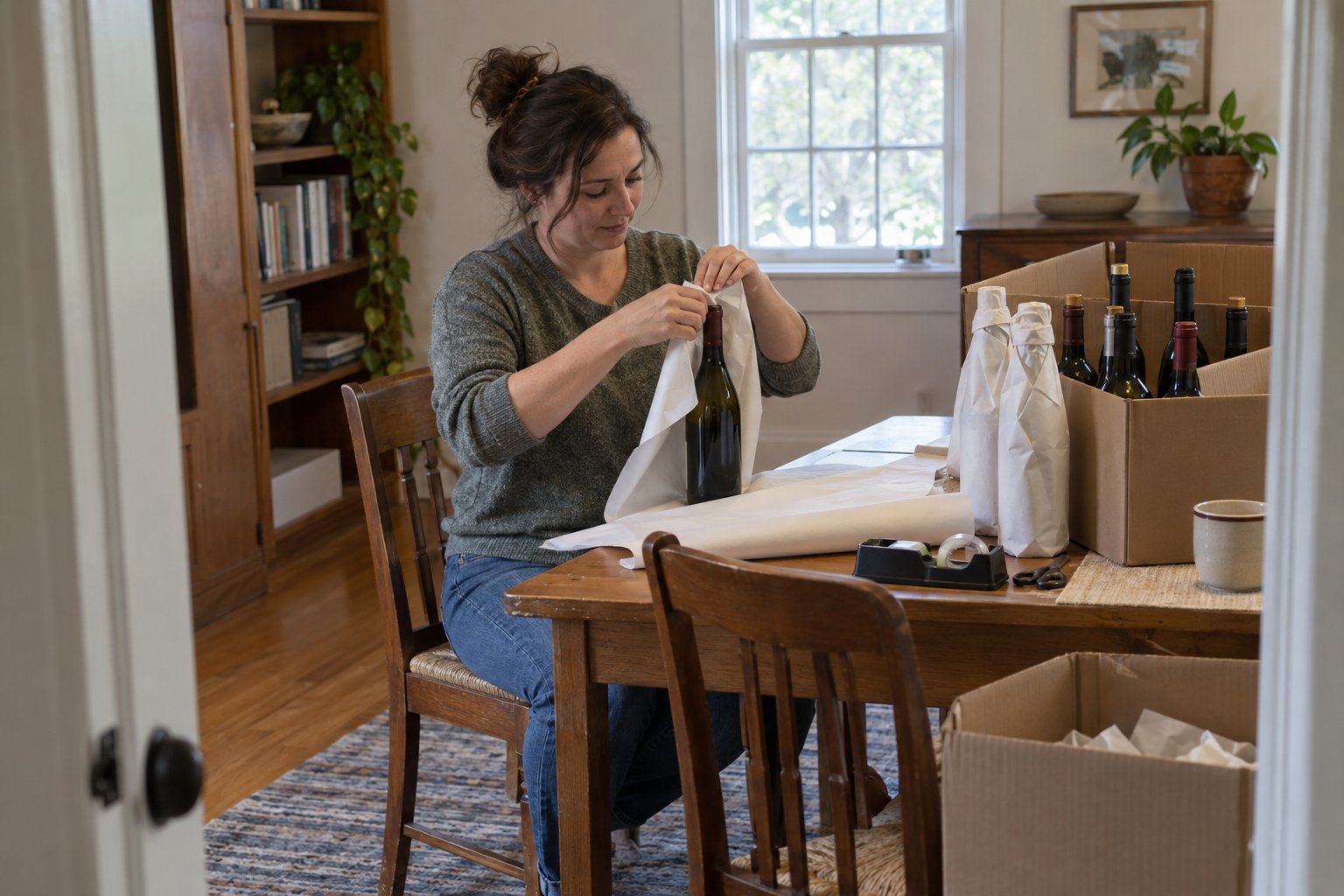
Wrap each bottle individually before it goes into its divided slot, even in a box with built-in cells. A single layer of packing paper or a foam sleeve absorbs small vibrations during transit and protects the label, which matters if any bottle has resale or sentimental value.
Orientation depends on the closure:
Tape each box shut and label it "Wine, Fragile, This Side Up" on at least two sides so it's obvious no matter how it's set down.
A built-in or freestanding wine fridge needs to sit at room temperature and unplugged for several hours before the move so refrigerant pressure stabilizes, similar to the rest period any compressor-based appliance needs. Empty it completely first since bottles left inside will shift and knock together once the unit is in motion.
Keep the unit upright during loading and transport rather than laid on its back or side, and give it the same settling time after it's plugged back in before loading it with bottles again. If the unit is heavy or built into cabinetry, moving the piece itself is a two-person job at minimum, and getting help with the heavy lifting is worth considering rather than wrestling it down a staircase alone. A straightforward way to handle that part of the job is to arrange for help carrying and loading the unit through the furniture pickup services this business offers, which can cover transporting heavy furniture and appliances as part of the rest of the load.
Wine boxes belong in the main cabin of the moving vehicle, not in an unheated trailer being towed behind, and never near the back doors where temperature swings the most. Load them after the heavy furniture is in place but before lighter, crushable boxes go on top.
If the drive is long enough that the truck will sit somewhere overnight, plan to load wine boxes last so they can come off first and spend the least time sitting exposed to outside temperatures.
Unpack wine boxes before anything else that was loaded last, since they've likely spent the most time exposed to temperature changes. Check each bottle for a cracked label, a popped or protruding cork, or any sign of seepage around the capsule before shelving it.
Let bottles rest for a day or two before drinking anything from the collection, especially older reds that may have had sediment disturbed during transport. Reshelve cork-finished bottles on their side right away rather than leaving them upright in a box, since an upright bottle sitting for days can let the cork dry out.
For a collection of more than a few cases, allow about an hour to sort, wrap, and box each case of twelve bottles if you're doing it carefully. Spreading that over two or three days before moving day, rather than trying to do it all the morning of, keeps you from rushing the one part of the move where rushing causes breakage.
If you're moving locally within the area, from Guilford, CT to Madison, CT for example, the drive itself is short enough that temperature exposure is a minor concern. A longer trip changes that calculation and calls for more planning around timing and how the boxes are loaded, since bottles spend more hours in transit the farther they travel.
Whatever the distance, give the crew advance notice of what the collection involves, including whether a wine fridge is part of the load, so the day can be planned around it rather than figured out on the spot.
Planning your move? Request a quote from CT Family First Movers.
Cork-sealed bottles travel best on their side so the cork stays moist and keeps its seal. Screw-cap bottles and most sparkling wine can be packed upright since there's no cork to maintain.
Give it roughly half a day to settle at room temperature before moving it, similar to other compressor-based appliances. Let it sit again after setup before refilling it with bottles.
Avoid it if at all possible. Load wine boxes last so they can be the first off the truck, and keep them in the climate-controlled cab area rather than an unheated trailer.
Let the crew know the size of the collection, whether any bottles are especially old or fragile, and whether a wine fridge is part of the load, so they can plan where it goes on the truck and how it gets handled.
Most wine shipping boxes are built around a standard twelve-bottle case, which is a useful unit to plan packing time and truck space around even if your collection is stored in mixed quantities.
Long distance moving throughout all of New England and the tristate area (NY, NJ, PA) as well!
From North Branford to communities across Connecticut, CT Family First Movers is here when you need residential, commercial, or long-distance moving services. Request your free quote today.